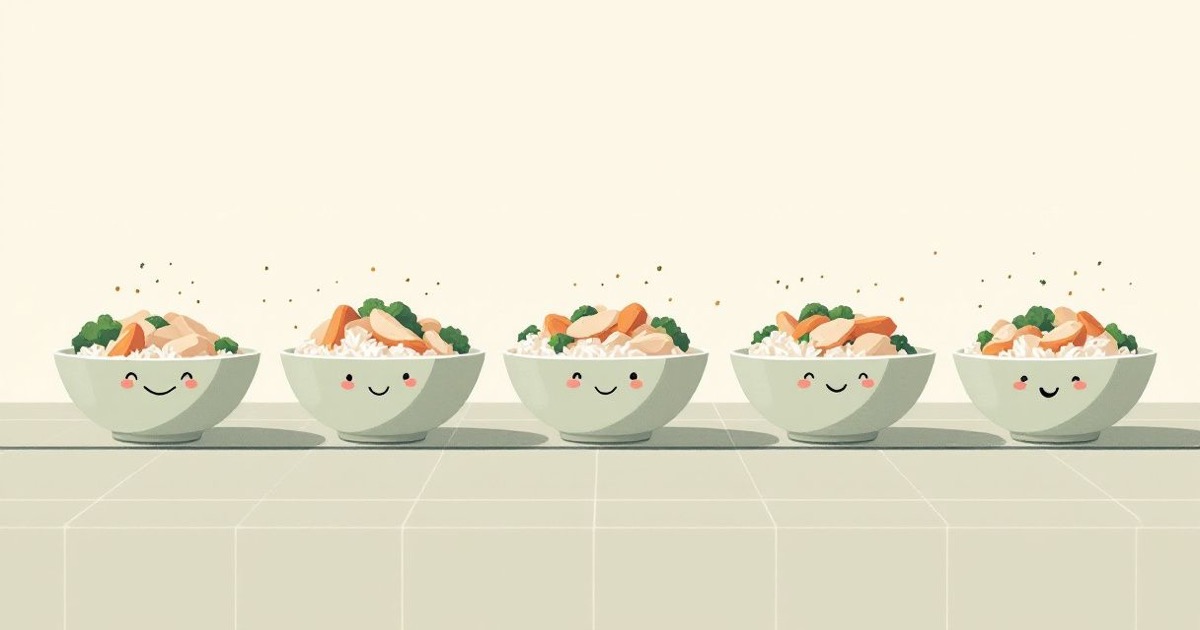
There is a person in your office who eats the same lunch every day. You know the one. Chicken, rice, broccoli, a container with a lid that closes with a sound like a small door. Colleagues have gone through stages of grief about it: curiosity, concern, an intervention disguised as "we're doing Thai, want in?" The person does not want in. The person has eaten this lunch roughly 900 times and will eat it again tomorrow, and — this is the part nobody tells you — the person is probably right.
For years the default advice has been the opposite. Variety is the spice of life. Eat the rainbow. Don't let your diet get boring or you'll quit. All of which sounds sensible and comes with a suspicious lack of citations. So let's look at what happens when researchers actually count.
The 2026 study that vindicated the meal-prep people
In March 2026, psychologist Charlotte Hagerman and colleagues at Drexel University published a paper in Health Psychology with a question that had somehow never been asked properly: do people who eat more repetitively lose more weight? They had the right data to answer it — the daily food logs of 112 adults with overweight or obesity during the first twelve weeks of a behavioral weight-loss program. From those logs they scored two things. Caloric stability: how much a person's intake swung from day to day and from weekday to weekend. And dietary repetition: what share of a person's foods were unique, and what share got logged ten or more times.
The repeaters won. Participants with the most routine diets lost 5.9% of their body weight on average; the variety-seekers lost 4.3%. For someone starting at 90 kg, that's the difference between losing about 5.3 kg and about 3.9 kg in the same twelve weeks, on the same program, with the same coaches. Day-to-day calorie swings mattered too: every extra 100 calories of daily fluctuation was associated with roughly 0.6% less weight lost. Hagerman's explanation is disarmingly simple: "Maintaining a healthy diet in today's food environment requires constant effort and self-control. Creating routines around eating may reduce that burden and make healthy choices feel more automatic."
The macaroni-and-cheese experiment
The Drexel study is observational — it shows repeaters lost more, not that repeating caused it. For causation you need a lab, a stopwatch, and a great deal of macaroni and cheese. In 2011, Leonard Epstein and colleagues at the University at Buffalo published exactly that in the American Journal of Clinical Nutrition. Thirty-two women — half with obesity, half without — were served the same macaroni-and-cheese meal five times. One group got it every day for a week. The other got it once a week for five weeks. Everyone could eat as much as they wanted.
The daily group got bored, in the most useful way possible. Their rated liking of the meal fell faster, and by the fifth serving they were eating less of it, while the once-a-week group — for whom mac and cheese remained an event — had drifted up by about 100 calories per meal. Same food, same women, same portion on offer. The only variable was how often they'd seen it. The effect held for both weight groups, which matters because it means this isn't a quirk of one kind of eater; it's how appetite works.
Psychologists have a name for the mechanism, coined by Barbara Rolls in 1981: sensory-specific satiety. The pleasantness of a food drops as you eat it, but only that food — which is why you can be completely full of roast dinner and still find room for dessert, and why a buffet is a machine for overeating. Variety resets the appetite. Monotony lets it wind down. A 2001 review by Raynor and Epstein pulled the threads together: more variety on the plate reliably means more calories eaten, and greater variety of energy-dense foods in particular tracks with higher body fat. The buffet knew this all along. It just didn't tell you.
The decision tax (and the statistic that turned out to be fake)
You have probably heard that you make more than 200 food decisions a day. It's a great number. It's been in every wellness article since 2007. In January 2026, researchers at the Max Planck Institute for Human Development in Berlin went back to the original study and found the figure was an artifact of the counting method — participants were asked to estimate decisions per meal across five dimensions, and the estimates were multiplied together into a number nobody ever actually observed. So, no: you do not make 226.7 food decisions a day. Sorry to the slide decks.
What survives the debunking is smaller and more useful. You make some food decisions a day, and each one is an opportunity to make the wrong one — at 3 p.m., tired, in front of a vending machine that has your number. The repeat-eater has pre-answered most of those questions. "What's for lunch?" is not a decision for them; it's a fact, like the time zone. This is the same logic behind the tech-executive uniform of identical grey T-shirts, except applied to something that actually affects your health. Nobody ever gained ten pounds from a spontaneous shirt.
Now the honest part: the caveats
If this were a social-media post, it would end here with a photo of seven identical containers. It's not, so here is what the research doesn't show. First, the Drexel study didn't assess the nutritional quality of anyone's repeated meals — eating the same pastry every morning is highly repetitive and not what anyone is recommending. Second, it's a correlation inside a coached program; the authors themselves say a randomized trial is needed. Third, dietary variety has real benefits the appetite research doesn't measure: the American Gut Project found people eating 30 or more different plant foods a week had markedly more diverse gut microbiomes than people eating fewer than ten, and micronutrient coverage is genuinely easier with a wider net.
So the sane version of this isn't "eat one meal forever." It's repeat the structure, rotate the details. Same breakfast every weekday. A lunch template — protein, grain, a pile of something green — with the vegetable and the sauce changing when you feel like it. Two or three dinners on rotation that you can cook without looking at a recipe. You get the appetite-quieting, decision-killing benefits of monotony while the plant count keeps climbing. The chicken-rice person, if you actually look in the container, has usually been doing this all along. The broccoli is sometimes green beans. They didn't announce it.
- Repeat the meals you eat when tired. Breakfast and weekday lunch are where autopilot helps most; leave dinner and weekends for variety if you want it.
- Keep the calories boring, not just the food. The Drexel data suggests day-to-day stability matters on its own — a wildly different Saturday undoes a steady week.
- Rotate inside the template. Swap the vegetable, the grain, the sauce. Structure stays, ingredients tour.
- Use boredom as a signal, not a failure. If a repeated meal has become genuinely unpleasant, sensory-specific satiety has done its job — retire it and promote another one.
- Check the template once. Have a look at the protein, fiber and micronutrients of your default meal one time, properly. Then you never have to think about it again.
The side effect nobody advertises: the boring diet is the easiest one to track
Here's a detail from the Drexel study that's easy to skim past: the evidence came from people's food logs. Every one of those 112 participants was writing down what they ate, and the repeaters were the ones whose logs kept getting filled in. That's not a coincidence. Logging a new dish means looking things up, guessing a portion, and arguing with a database about what counts as a "medium" bowl. Logging the same lunch you've had 900 times takes four seconds, because you already know what's in it and so does whatever you're logging it into.
That's the quiet loop underneath all of this. Repetition makes eating easier, which makes tracking easier, which makes staying consistent easier, which — per the Drexel numbers — is where the results actually come from. Consistency of logging beats precision of logging, and nothing makes logging more consistent than having almost nothing new to log. The people who quit tracking apps usually quit because every meal was a small research project. The boring-lunch person never had that problem.
If lunch is one sentence, logging it should be too
VoiceLog lets you say what you ate — "chicken rice bowl with broccoli, the usual portion" — and files it with calories and macros, transcribed on your iPhone. No database searching, no portion sliders, nothing that gets harder on day 900. Free to start.
Get VoiceLogSo, is it bad to eat the same thing every day?
Not if the thing is reasonable and you rotate around it. The evidence, such as it is, points the other way: repetition quiets appetite, removes the decisions you're worst at, keeps calories stable, and — as a bonus — makes tracking almost free. The costs are real but manageable: keep the plant count up, check your default meal's nutrition once, and retire meals when they genuinely bore you rather than when a colleague raises an eyebrow. Habits form fastest when the behavior is identical every time, and a meal you don't have to think about is the most identical behavior there is.
So the next time someone opens the container with the little door sound and the office collectively sighs, consider that they may be the only person in the room who has solved lunch. The rest of us are still deciding.
VoiceLog: speak it, it's logged
Meals with calories and macros, workouts, expenses, journal — all logged by voice, on-device, in seconds. Boring lunch optional. Free on iPhone.
Get VoiceLogEating the same meals every day: common questions
Is it bad to eat the same thing every day?
Not inherently. A 2026 Drexel University study in Health Psychology found people with more repetitive diets lost more weight (5.9% vs 4.3% over 12 weeks), and lab research shows repeated foods become less appetizing, so you eat less of them. The risks are nutritional: if the repeated meal is poor quality or your total plant variety is low, you can miss micronutrients and reduce gut-microbiome diversity. Repeat a balanced template and rotate the ingredients inside it.
Does eating the same meals every day help you lose weight?
The evidence suggests it helps. In the Drexel study, both meal repetition and day-to-day calorie stability predicted greater weight loss, and every extra 100 calories of daily fluctuation was linked to about 0.6% less weight lost. A 2011 experiment found women served the same macaroni and cheese daily ate less of it by the end of the week, while women served it weekly ate more. The likely mechanisms are sensory-specific satiety and fewer food decisions. The study was observational, so it shows association rather than proof.
Why do I get bored eating the same food, and is that bad?
Boredom with a repeated food is sensory-specific satiety: the pleasantness of a specific food drops with repeated exposure. It's a normal appetite mechanism, and it's part of why repetition reduces intake. If a meal becomes genuinely unpleasant, swap it for another balanced default rather than forcing it — the benefit comes from routine, not from any particular dish.
How much food variety do you actually need?
Enough to cover protein, fiber, and micronutrients, and enough plant diversity for gut health — the American Gut Project associated 30+ different plant foods a week with more diverse microbiomes. You can hit that while repeating meals by rotating vegetables, grains, legumes, nuts and herbs within a fixed meal structure. Repetition of structure and variety of ingredients aren't in conflict.
What is the easiest way to track calories if I eat the same meals?
Repeated meals are the easiest to track because there's nothing new to look up. Check your default meals' nutrition once, then log them quickly each time — with a voice-logging app you can simply say the meal and portion in one sentence and have calories and macros filed automatically. Consistency of logging predicts results more than precision, and repeated meals make consistency almost effortless.