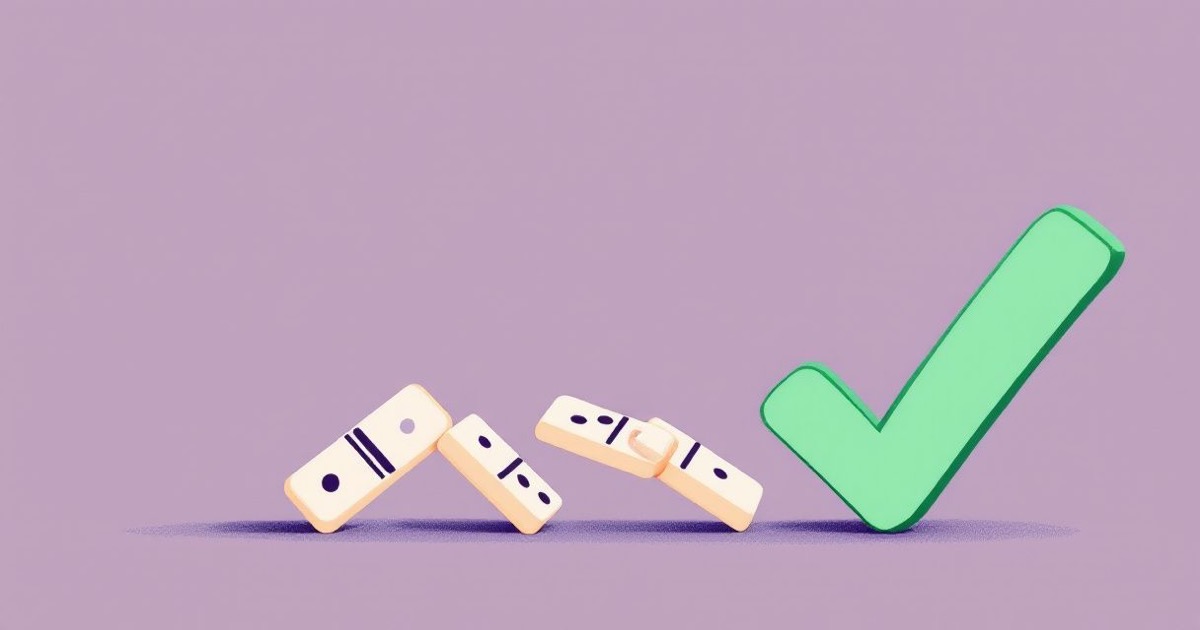
Habit stacking has become the default answer to "how do I actually stick to this?" — recommended by every productivity newsletter, usually with the same example about doing push-ups after brushing your teeth. The formula, popularized by James Clear in Atomic Habits (the term itself comes from author S.J. Scott, and the underlying method from Stanford's BJ Fogg), is one sentence: after [current habit], I will [new habit]. After I pour my coffee, I will write one sentence. After I close my laptop, I will put on my running shoes.
Because it's everywhere, it has also acquired the smell of an overhyped life hack — which is a shame, because habit stacking is one of the few pieces of self-improvement advice sitting on top of a genuinely large body of evidence. It also fails constantly, for reasons the newsletters rarely mention. This article goes through the questions people actually type into search engines about habit stacking, with what the research says: what it is, whether it works, why your stacks keep collapsing, and how many habits you can realistically chain together.
What is habit stacking, exactly?
Habit stacking means using an existing behavior — something you already do automatically every day — as the trigger for a new one. Instead of relying on motivation ("I'll meditate more") or on the clock ("I'll meditate at 7am"), you rely on a behavior that already happens: after I sit down on the train, I will meditate for two minutes. The existing habit is the anchor; the new habit rides on it.
The reason behavior scientists like this design is that an action is a more reliable cue than a time. You might not notice that it's 7:15. You will always notice that you just poured coffee, because pouring coffee is something you do with your hands, in a place, with a smell. BJ Fogg, who ran Stanford's Behavior Design Lab and built his Tiny Habits method around this idea, calls the existing behavior an anchor precisely because it holds the new habit in place while automaticity forms — which, per the habit-formation research, takes an average of 66 days, not the mythical 21.
Does habit stacking actually work? What does the science say?
Yes — with the caveat that what's been studied rigorously is the general mechanism, not the branded technique. Habit stacking is a specific form of what psychologists call an implementation intention: a plan that links a concrete situational cue to a concrete response ("when X happens, I will do Y"). Implementation intentions are among the best-replicated findings in behavior change. A meta-analysis by Peter Gollwitzer and Paschal Sheeran covering 94 studies and over 8,000 participants found a medium-to-large effect (d = 0.65) on goal attainment — in practical terms, people who specified the exact cue and response were two to three times more likely to follow through than people who merely stated a goal.
The effect shows up across domains that matter: exercise frequency, healthy eating, medication adherence, flu shots. What habit stacking adds to the classic implementation intention is choosing a behavior as the cue instead of a time or a place — a sensible refinement, since existing routines fire reliably even on chaotic days. The honest summary: the engine is proven; the specific "stack" packaging is a well-designed way to use it, not a separately verified miracle.
What are good habit stacking examples?
Good stacks share a shape: the anchor is rock-solid daily, the new behavior is small enough to do on a bad day, and the two happen in the same place at the same natural frequency. Some that survive contact with real life:
- After I pour my morning coffee, I write down the one thing that would make today a win.
- After I finish lunch, I log what I ate — while it's still in front of me, not at 10pm from memory.
- After I tap my card on the bus, I log the expense before putting the phone away.
- After I park at the gym, I say my workout plan out loud before leaving the car.
- After I plug my phone in at night, I write one line about how the day went.
- After I close my laptop for the day, I do ten squats before leaving the desk.
Notice that several of the strongest examples are logging habits — food, spending, one-line journaling. That's not a coincidence: tracking is the habit that makes every other habit visible, and it's also the one people abandon fastest, which makes it the single best candidate for stacking. More on that below.
Why does my habit stack keep falling apart?
Stacks fail in four predictable ways, and none of them is a willpower problem:
- The anchor is vaguer than you think. "After breakfast" is not a moment — breakfast ends differently every day. Fogg's advice is to anchor to the last concrete physical action: after I put my bowl in the sink. If the cue is fuzzy, the whole stack is fuzzy.
- The new habit is too big. "After I pour coffee, I will journal for 20 minutes" works until the first rushed morning, and then the broken chain teaches you the stack is optional. Shrink the behavior until it fits your worst day — one sentence, two push-ups, one logged meal. You can always overshoot.
- Frequency or location mismatch. Anchoring a daily habit to something you do three times a week — or a kitchen habit to an anchor that sometimes happens in the car — breaks the cue-response link the research depends on. Match daily to daily, place to place.
- The friction lives in the middle. If the new habit requires unlocking a phone, opening an app, and navigating three screens, the stack has a toll booth in it. Every step between cue and behavior is a place the stack can die.
The hardest habit to stack is the one that tracks the others
Here's the uncomfortable pattern in the habit literature: the behavior with the best evidence behind it — self-monitoring, i.e. writing down what you eat, spend, or do — is also the one with the worst adherence. People who track their meals lose more weight; people who track spending spend less; and yet most people abandon tracking apps within weeks, because traditional logging fails the friction test above. Open app, search database, pick serving size, adjust sliders: that's a toll booth with four gates, standing between the cue (finishing lunch) and the behavior (having logged lunch).
Make the logging habit small enough to stack
VoiceLog collapses the toll booth to one step: say a sentence, done. "After lunch, I log it" becomes speaking "chicken wrap and a flat white" — calories and macros filed automatically, on-device. Same for "spent 12 euros on a taxi" or "30-minute run." When the behavior takes five seconds, the stack has nowhere left to break. Free to try.
Get VoiceLogHow many habits can I stack together?
Fewer than the productivity videos suggest. Long chains — wake, hydrate, meditate, journal, stretch, read — look great in a notebook and share a single point of failure: miss the first link on one groggy Tuesday and the whole morning collapses. The research on automaticity is per-behavior; each link needs its own weeks of repetition before it stops costing effort. Start with one stack, run it until the new behavior feels strange to skip — for most people somewhere in Lally's 18-to-254-day range — then add the next. Two or three mature stacks beat a six-link chain that works only on perfect days.
And if you're starting this week, you have a mild tailwind: new-season moments like early September measurably boost commitment to fresh routines — the fresh start effect — as long as the routine you commit to is small enough to survive week three, when the novelty wears off and only the anchor is left holding it.
The one-sentence version
Habit stacking works because concrete cues beat good intentions two-to-one in nearly a hundred studies — but only if the anchor is precise, the behavior is embarrassingly small, and nothing stands between them. Pick one existing routine, bolt one five-second behavior onto it, and let repetition do the slow work motivation can't.
One sentence after any anchor
Meals, workouts, expenses, moods, todos — VoiceLog files them all from a single spoken sentence, transcribed on your iPhone. Stack it after coffee, after lunch, after the gym, and ask Claude or ChatGPT about your patterns later via MCP. Get it free on the App Store.
Get VoiceLogFrequently asked questions
Does habit stacking actually work?
Yes. Habit stacking is a form of implementation intention — linking a concrete cue to a concrete response — and a meta-analysis of 94 studies with over 8,000 participants (Gollwitzer & Sheeran) found a medium-to-large effect on follow-through: people using cue-linked plans were roughly two to three times more likely to act than people who only set a goal. The stack's anchor behavior is simply a more reliable cue than a time of day.
What is the habit stacking formula?
"After [current habit], I will [new habit]." For example: after I pour my morning coffee, I will write one sentence in my journal. The current habit must be something you already do automatically every day, in the same place, and the new habit should be small enough to complete even on your worst day.
Why does my habit stack keep failing?
Usually one of four design flaws: the anchor is vague ("after breakfast" instead of "after I put my bowl in the sink"), the new behavior is too big for a bad day, the anchor and habit mismatch in frequency or location, or there's friction between cue and behavior — like an app that takes four steps to open. Shrinking the behavior and sharpening the anchor fixes most broken stacks; willpower is rarely the issue.
How long does it take for a stacked habit to become automatic?
The same as any habit: Phillippa Lally's UCL study found an average of 66 days to automaticity, with a range of 18 to 254 days depending on the person and the behavior's complexity. Stacking doesn't shorten the road — it makes you far less likely to fall off it, and missing a single day has no measurable effect on the process.
How many habits should I stack at once?
Start with one. Each new behavior needs its own weeks of repetition to become automatic, and long chains share a single point of failure — miss the first link and the whole routine collapses. Add a second stack once the first feels strange to skip. Two or three durable stacks beat an ambitious six-link morning routine that only works on perfect days.