Why Macro Tracking Feels Like a Part-Time Job
Tracking calories is one number per meal. Tracking macros is four: calories, protein, carbs, and fat — and in a traditional macro tracker app, each of those depends on getting the exact food entry and portion right. That's why the standard macro workflow involves a food scale, a database search per ingredient, and a spreadsheet mentality about dinner.
For a competitive bodybuilder in prep, that rigor is the point. For everyone else — people who lift a few times a week and mostly want to hit a protein target while keeping calories in range — it's wildly over-engineered. The result is familiar: most people who start macro tracking quit within weeks, not because macros stopped mattering but because the bookkeeping did them in.
- Four numbers per food instead of one multiplies decisions per meal
- Mixed dishes (curries, stir-fries, sandwiches) resist per-ingredient entry
- Eating out means guessing anyway — after doing all the search work
- The habit collapses the first busy week
PFC From a Sentence: How Voice Macro Tracking Works
VoiceLog replaces the database hunt with description. Tap the mic and say:
"Grilled salmon, about 200 grams, with a cup of rice and roasted broccoli."
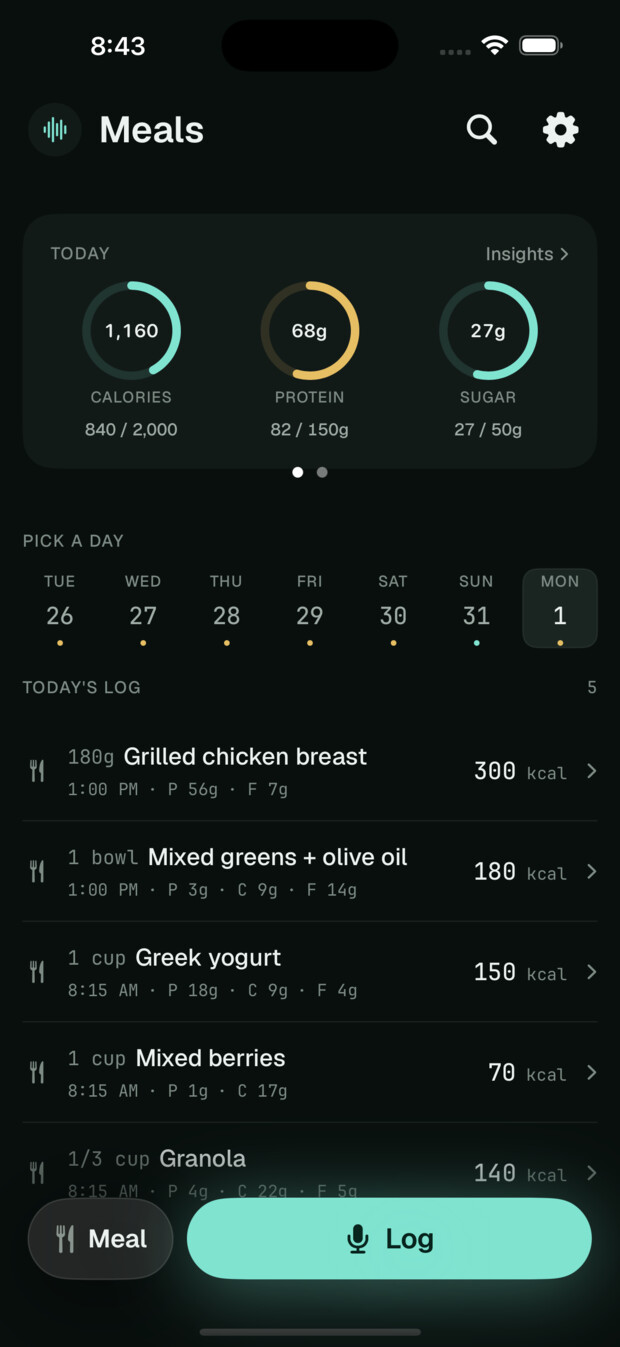
VoiceLog transcribes the sentence on your device (the audio never leaves your phone), interprets the foods and portions, and files a meal with calories, protein, carbs, fat, and sugar estimated — the full PFC breakdown, from a sentence, in about five seconds. No entry to pick, no serving-size dropdown, no recipe builder.
The same recording can also carry your training: "...and I did bench press, 3 sets of 8 at 80 kilos" files a workout entry alongside the meal. Food and the training it fuels end up in one log, from one breath. (New to voice-first logging? Start with the voice calorie tracking guide.)
Your Protein Target, Front and Center
For most lifters and weight-loss dieters, protein is the macro that actually needs managing — carbs and fat mostly follow from the calorie budget. VoiceLog's Home screen is built around that reality: one daily snapshot shows protein alongside calories, deficit, steps, and spending. You glance at it at 4pm, see you're 60 grams short, and dinner plans itself.
Streaks reinforce the habit. Logging every day — not logging perfectly — is what keeps the running protein number trustworthy, and a visible streak is a surprisingly effective reason not to skip the post-lunch sentence.
How Accurate Are Spoken Macro Estimates?
The honest answer: accurate enough for the goals most people track macros for, and the accuracy scales with the detail you give.
| What you say | Estimate quality |
|---|---|
| "Chicken and rice" | Reasonable — assumes typical portions |
| "A chicken breast with a cup of rice" | Good — countable units pin the portions |
| "200g grilled chicken breast, 150g cooked jasmine rice, a tablespoon of olive oil" | Tight — close to weighed-and-searched logging |
Note what that last row implies: if you already weigh your food, voice logging doesn't take that away — you just say the weights instead of typing them into search boxes. You keep the precision and drop the data entry. And every entry stays editable, so you can nudge a number when you know better.
Practical Playbooks
Hitting a protein target while cutting
Log each meal in a sentence as you eat it. Check the Home snapshot mid-afternoon; if protein is behind, front-load it at dinner. Your deficit and protein sit on the same screen, so you never trade one for the other blindly. This estimate-first approach pairs naturally with CICO — more on that in the MyFitnessPal alternative comparison.
Repetitive meals, near-zero effort
If you meal-prep, your sentences get short: "my usual chicken and rice lunch, plus an apple." Consistent meals make estimates consistent, which is exactly what trend-based tracking needs.
Eating out without giving up
Restaurant meals are where database trackers quietly fail — you were guessing anyway. Describe what was on the plate and move on. Pro users can also snap a photo of the meal and let VoiceLog estimate from the image.
Query Your Macros Like Data
Because every spoken meal becomes structured data, your history is more than a diary. With VoiceLog Pro you can connect Claude, ChatGPT, or any MCP-compatible assistant to your logs and ask things like "what was my average daily protein over the last two weeks?" or "which dinners kept me under 700 calories?" — answers computed from your real entries. The full setup lives in our guide to querying your logs with AI.
Honest Limitations
Voice macro estimates are estimates. For packaged foods with printed labels, a barcode-based tracker is strictly more exact, and for contest prep or clinical protocols where every gram is audited, a scale plus a database remains the gold standard. Estimates also inherit your description: vague sentences produce looser numbers (though you can always edit). VoiceLog is English-first today, iPhone-only (iOS 18+), and the free tier limits recording length — longer recordings are part of Pro. If your goal is a sustainable protein habit rather than a laboratory log, none of these should be blockers; if it's the latter, be honest with yourself about which tool fits.
Frequently Asked Questions
Which macros does VoiceLog estimate?
Every meal gets calories, protein, carbohydrates, fat, and sugar estimated from your description. All values are editable after the fact.
Can I track protein without tracking everything else?
Effectively yes — log your meals normally and just watch the protein number on the Home snapshot. There's no requirement to review carbs and fat if protein is your focus.
Do I need to weigh my food?
No, but you can. Say weights when you know them ("200 grams of chicken") for tighter estimates, or speak casually and accept typical-portion assumptions. Both beat not logging.
Does it handle supplements and shakes?
Yes — "a scoop of whey in water" logs like any other food, with protein estimated. Naming the brand or the scoop's protein content sharpens the number.
Is voice macro tracking free?
Yes. Voice meal logging with full macro estimates is in the free app. VoiceLog Pro ($12.99/month or $99.99/year, 7-day trial) adds meal-photo scanning, AI assistant connections, longer recordings, and cross-device sync.
The Bottom Line
Macros matter most when they're measured consistently, and consistency is a function of effort. A protein tracker that costs five seconds per meal is one you'll still be using when the results show up. Say the meal; let the app do the arithmetic.