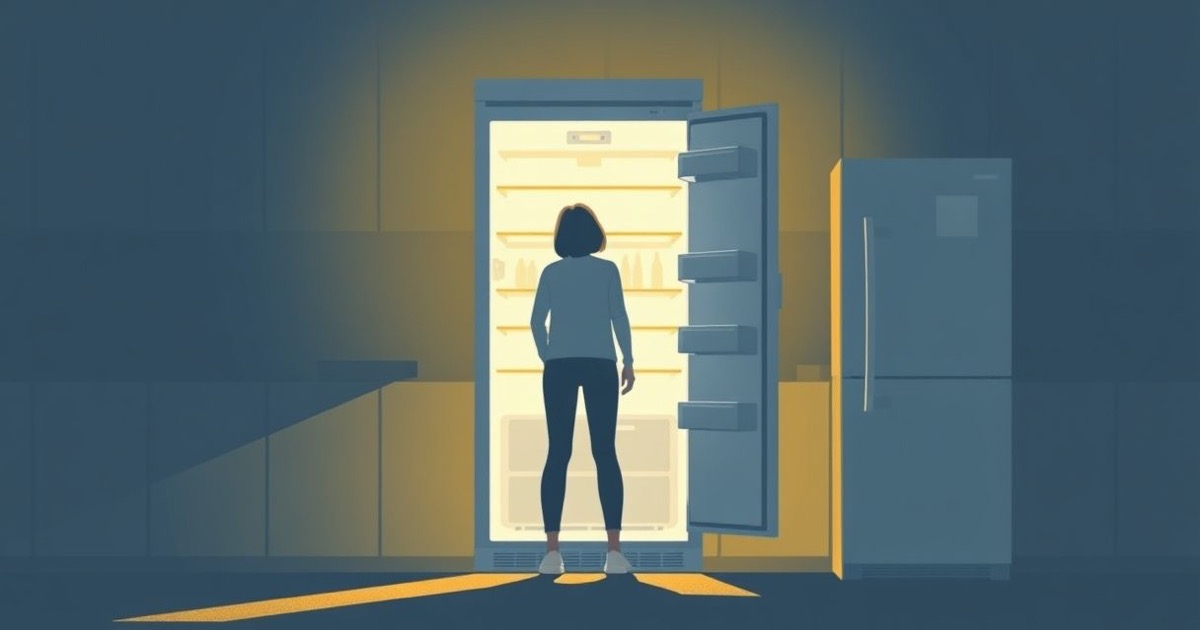
It's 9:40 on a Tuesday night and Maya is standing in the light of the open refrigerator for the third time since dinner. She isn't going to eat anything — probably. She's just looking. She ate 1,400 calories today, exactly what the app prescribed. She had a salad with grilled chicken, a protein bar, a "balanced" frozen bowl. She did everything right. And she is so hungry she's reading the mustard label like it's a menu.
If you've dieted, you've been Maya. And you've probably drawn the conclusion every dieter draws at the fridge door: I'm weak. Other people can do this. I can't. Here's the thing the research is unambiguous about — that conclusion is wrong. The hunger is not a character flaw. It's a predictable, measurable hormonal response, and it has specific, fixable causes. Willpower isn't the lever. Biology is.
Your body noticed, and it's fighting back
When you eat less than you burn, your body doesn't quietly comply. It escalates. In a landmark 2011 study in the New England Journal of Medicine, Priya Sumithran and colleagues put 50 adults on a 10-week very-low-calorie diet and then tracked their appetite hormones. Ghrelin — the "eat now" hormone secreted by the stomach — rose significantly. Leptin — the fat-tissue hormone that tells your brain you're fed — fell. Subjective hunger went up. The kicker: a full year later, the hormones still hadn't returned to baseline. The participants' bodies were still arguing for the lost weight back, twelve months on.
So the fridge-door feeling isn't imaginary and it isn't weakness. It's an appetite system doing exactly what it evolved to do when energy runs short. You can't out-discipline it. But you can absolutely out-engineer it — because most diet hunger isn't caused by the deficit itself. It's caused by how the deficit is built.
Culprit one: your deficit is too aggressive
Maya's app gave her 1,400 calories because she asked it to deliver results fast. That's the first problem. Hunger hormones scale with the size of the energy gap: the deeper the cut, the louder the ghrelin. A deficit of 300–500 calories a day produces slower scale movement but dramatically quieter appetite than the 750–1,000-calorie gaps people default to in January. Slower diets also preserve more lean mass and — the part nobody advertises — they're the ones people actually finish. A modest deficit you can hold for eight months beats a brutal one you abandon in week three, every single time.
Culprit two: not enough protein (the leverage effect)
Biologists Stephen Simpson and David Raubenheimer spent years feeding controlled diets to everything from locusts to humans and kept finding the same pattern, now called the protein leverage hypothesis: animals keep eating until they hit their protein target, almost regardless of how many calories that takes. Dilute the protein in the food supply and total energy intake climbs. Humans in their experiments who were switched to a 10%-protein diet ate roughly 12% more total calories than on a 15%-protein diet — most of it as snacking between meals.
The flip side is the most useful satiety finding in the literature. In a 2005 trial by David Weigle's group, participants who raised protein to 30% of calories — with everything else ad libitum, meaning they could eat as much as they wanted — spontaneously ate about 440 fewer calories a day and reported less hunger doing it. No counting, no restriction, just protein displacing the drive to eat. If you're constantly hungry on 1,400 calories, the first question isn't "how do I suffer better?" It's "how many grams of protein am I actually getting?" For most chronically hungry dieters the honest answer is 60 grams on a good day.
Culprit three: your calories have no volume
Your stomach has stretch receptors, and they vote on fullness independently of calories. Barbara Rolls's volumetrics research at Penn State showed this repeatedly: people eat a fairly consistent weight of food per day, so foods with low calorie density — soups, fruit, vegetables, potatoes — fill the same stomach for a fraction of the energy. A 500-calorie pastry occupies the space of a fist; 500 calories of chicken, rice and roasted vegetables barely fits on a plate. Ultra-processed foods run the same trick in reverse: in Kevin Hall's tightly controlled 2019 NIH ward study, people offered ultra-processed meals ate about 500 calories a day more than the same people offered unprocessed meals matched for macros — and they ate faster, outrunning their own fullness signals. Fiber compounds the effect, which is why the fiber-first crowd is onto something real.
Culprit four: you're tired, and tired reads as hungry
In Eve Van Cauter's sleep-restriction experiments at the University of Chicago, two nights of four-hour sleep raised ghrelin about 28% and dropped leptin about 18% — and cravings shifted specifically toward calorie-dense, high-carb foods. Short sleep is functionally an appetite stimulant. If your hunger is worst in weeks when you're averaging six hours, the fix isn't a new diet. And stress runs a parallel channel: elevated cortisol reliably pushes intake toward exactly the foods you're trying to limit. The fridge at 9:40 p.m. is often not about dinner being too small. It's about the day being too long.
Find your hunger pattern by saying it out loud
You can't fix a hunger problem you haven't measured. VoiceLog makes the measuring nearly free: say "chicken wrap and an apple, still hungry after" and it logs the meal, calories, macros — and your note — in one sentence, transcribed on-device. A week of that and the pattern is sitting in your log: the 60-gram protein days are the fridge-door nights, the short-sleep days are the snack days. That's the diagnosis. The fix follows from it.
Get VoiceLogCulprit five: hunger you never diagnose, because logging is miserable
Here's the quiet reason most people never figure out which culprit is theirs: diagnosing hunger requires data, and traditional tracking is so tedious that most people quit within weeks. Searching a database for "homemade lentil curry," weighing rice, scanning barcodes at a restaurant — the friction guarantees the log dies exactly when it would have gotten useful. But the diagnosis doesn't need lab-grade precision. It needs a consistent record of three things: roughly what you ate, roughly how much protein was in it, and when the hunger hit. That's it. Consistency beats accuracy — a scrappy log you keep for a month tells you more than a perfect log you keep for four days.
The five levers, in order
- Shrink the deficit before you shrink yourself. If you're ravenous daily, add 150–200 calories back. A deficit you can't feel is a deficit you can finish.
- Front-load protein. Aim for 25–35 grams per meal, starting with breakfast — eggs and Greek yogurt outlast toast and juice by hours. Target roughly 1.6 g per kg of body weight.
- Buy fullness with volume and fiber. Soup, fruit, vegetables, potatoes; minimize the ultra-processed stuff that Hall's study showed smuggles in 500 extra calories without extra satisfaction.
- Protect sleep like it's a macro. Under seven hours, your hormones are working against you before breakfast.
- Log meals and hunger together for two weeks. Not forever — two weeks. Pattern first, then fix. Most people find one culprit doing 80% of the damage.
Back to the fridge
Maya's story has a boring, happy ending, which is the best kind in nutrition. She raised her calories to 1,650, moved protein to every meal, and started noting hunger next to her food log. Two weeks in, the pattern was embarrassing in its clarity: fridge-door nights followed sub-70-gram protein days almost perfectly. The 9:40 p.m. staring contest mostly stopped — not because she got stronger, but because she stopped needing strength. That's the actual endgame of appetite science: not white-knuckling past hunger, but building days where hunger doesn't show up to the fight.
Two weeks of one-sentence logs
That's the whole experiment: speak each meal into VoiceLog for two weeks — calories, protein and your hunger notes captured in seconds, processed on your iPhone, shareable with Claude or ChatGPT over MCP if you want an AI to read your pattern back to you. Free to start. The fridge light deserves a night off.
Get VoiceLogFrequently asked questions
Why am I always hungry in a calorie deficit?
Because a calorie deficit triggers real hormonal countermeasures: ghrelin (the hunger hormone) rises and leptin (the satiety hormone) falls, and research shows these changes can persist for a year after dieting. The hunger is usually amplified by fixable factors — a too-aggressive deficit, low protein intake, low-volume ultra-processed foods, and short sleep — rather than by lack of willpower.
How do I stop being hungry while losing weight?
Work the levers in order: moderate the deficit to 300–500 calories a day, raise protein to 25–35 g per meal (about 1.6 g per kg of body weight daily), build meals around high-volume, high-fiber foods like soups, fruit and vegetables, sleep at least seven hours, and log meals alongside hunger for two weeks to find your specific trigger. In one trial, simply raising protein to 30% of calories led people to spontaneously eat about 440 fewer calories a day with less hunger.
Is constant hunger a sign my calorie deficit is too big?
Often, yes. Hunger-hormone responses scale with the size of the energy gap, so daily ravenous hunger — especially with poor sleep, irritability, or obsessive food thoughts — usually means the cut is too deep. Adding 150–200 calories back typically costs little on the scale but massively improves adherence, and adherence, not deficit size, is what predicts long-term weight loss.
Does protein really reduce hunger?
Yes — it's one of the most replicated findings in appetite research. The protein leverage hypothesis shows people keep eating until they hit their protein target, so low-protein diets drive overeating. Trials show high-protein diets increase satiety hormones, slow digestion, and cut spontaneous intake by hundreds of calories a day. If you're constantly hungry, an honest protein count is the first diagnostic to run.
Why am I hungrier when I sleep badly?
Sleep restriction directly shifts appetite hormones: in University of Chicago experiments, two nights of four-hour sleep raised ghrelin roughly 28% and lowered leptin roughly 18%, while cravings tilted toward calorie-dense carbs. Short sleep effectively works as an appetite stimulant, so hunger that spikes in exhausting weeks is a sleep problem wearing a diet costume.